Pages

Monday, 31 October 2011

Warm Bodies

It's Halloween, which means of course it's time for a vaguely Halloween-themed blog post! And, since it's been a long while since I posted a proper book review on this blog (not counting my review of the Hitchhiker's Guide to the Galaxy, which was published on the Cult Den), it's also time for a book review post. So how to combine the two? Well, quite recently I conveniently read a book starring a zombie as its main character, and nothing says Halloween like the shambling undead. So today I'll be reviewing Warm Bodies by Isaac Marion.

Warm Bodies did not sound like the kind of book I would want to read. A basic summary of the plot - 'R', a nameless zombie with no memories of his past life, falls in love with a human survivor he meets in the city named Julie. That does not sound like a good book to me. It sounds like one of the countless hastily put-together Twilight copies that have sprung up in the last three years, working on the basic outline of 'a love story where one of the romantic leads is a supernatural creature'. To make things worse, there's a quote from Stephanie Meyer on the front cover which proclaims 'I never thought I could care so passionately for a zombie... the most unexpected romantic lead I've ever encountered.' If I had seen this book on the shelf at a bookstore, there's no way I would have picked it up. Which is worrying, because Warm Bodies is actually a great novel.

The best thing about this book, quite simply, is R. He is beyond brilliant as a character and as a protagonist, perfectly crafted and tailor-made for the story. The book is told from his perspective, and his inner dialogue is what elevates the story to its high status. This tale wouldn't work from a third person POV; only through the eyes of R do we see the true complexity of Marion's writing. As a zombie, R is unable to speak in anything other than short, monosyllable sentences. In his mind, however, he is brooding, introspective and contemplative. The book moves at a slow pace because everything R does or sees, he analyses, reads into, mulls over in his head. So much of the story is told through R's philosophical monologue, and for most novels or stories this wouldn't work. On this occasion, however, it fits perfectly - at the novel's start, he is stuck in the dull and repetitive routine of zombiehood, and as such has plenty of time for mental discourse. It was a stroke of genius on the writer's part to make speech so difficult for R, as the gap between what R thinks inwardly, and what he is able to express outwardly, is a central theme in the novel, and a massively endearing character flaw. R is unable to speak his mind, has his freedom of speech stripped from him - not because of tyranny or dictatorship, but because he physically cannot form the words he needs to articulate his thoughts into sentences. This makes him easy to sympathise with; you will care about him more than you ever thought you could for a zombie. Stephanie Meyer got that right, at least.

Marion takes some liberties with the established mythos of zombies so that they work for his story, and for the most part does an admirable job of it. The zombies in Warm Bodies, outwardly, are still the shuffling, groaning corpses, who infect you with a bite and die only if you aim for the head. Inwardly, however, the author has redesigned them completely; these are not the instinctive, non-sentient, predatory zombies of World War Z, the most popular versions of the creature. The zombies in Warm Bodies are more akin to vampires. They are still cognitive, intelligent even in some cases, and capable of rational thought and logic; but the limitations of their decaying bodies prevent them from conveying this, and their insatiable hunger for human flesh drives them inexorably onwards, quite like a vampire's thirst for blood. Because he stamps his own signature on them, but does not make the mistake of altering them beyond recognition, Marion is able to develop an original story within the confines of a tired genre.

Warm Bodies is at its strongest when it is developing its characters, and R is not the only example of this. All of the story's major players are well rounded and interesting. M - a bald, bearded zombie and R's best friend - is as close to comic relief as the book gets, and is unusual amongst the zombie horde in that he possesses a sense of humour. He isn't as layered or developed as some of the other characters, but that suits and begets his role in the story as a comedy sidekick of sorts (albeit a morbidly macabre one). He still manages to lighten the mood in each of his scenes, both for R and for the audience, and provides a much needed change of tone at several points in the otherwise mostly bleak novel. Grigio, the leader of the human survivors, is an excellent foil, pushing the story forward and creating tension and suspense in a story which otherwise moves at a very leisurely pace. He is something of an archetype more than an original creation, but like with M, that fits his role in the story. Perry is a particularly interesting character who plays a very unusual role in the story, which I won't spoil; I will say, however, that he is one of the best examples of retroactive character development I've ever read.

What is one of the only problems I have with the book, unfortunately, is with one of the most important characters, Julie. As an individual, she is superb, with a hundred different layers of nuance to her personality and a well-defined world view that makes it easy to see her point of view in most situations. What I take issue with, sadly, is her relationship with R, the relationship that the whole story is built on and around. Now don't go grabbing the torches and pitchforks just yet; the relationship between the two characters is not badly done or poorly written, far from it. From around the time R attempts to take Julie home, through the city, the development between the two is word-for-word perfect, and something Marion should be applauded for. But Julie's initial reaction to R, for me at least, was a little unbelievable. Surely, having been left alone by R following the slaughtering of all of her friends and fellows, a character as strong-willed and determined to survive as Julie would have attempted some kind of escape? There's also the factor of her relationship with Perry, and how quickly she moves on from him (though admittedly, this is retconned later in the story through her discussions with R about Perry), which stretched my suspension of belief a little too thin. The relationship still works and is still wonderfully written, it's just that there are a few bumps along the way.

Bits and Bobs

  • If you have good observational skills, you've probably noticed by now how the character names - R and Julie - match up with those of Romeo and Juliet, reflecting the similarities between the two stories of forbidden love. I must admit, despite the fact that I had been told beforehand the story was very similar to Romeo and Juliet, I only noticed this similarity of names a while after reading the book. If you read a little further into things, M could also be compared to Mercutio, as he acts as the funny to R's serious, and is the main source of comedy in the story.
  • If you're unsure as to whether you would enjoy the book, I really recommend checking out some of Isaac Marion's short stories. They're all available for free on his website, and they really show off his writing - they demonstrate both how clever his ideas are, and how amazingly he can put them down on paper. In particular, check out Somnia, Pixel, What it Was Like For Jerry Being Immortal, That's Not Me and the Angriest Stoplight.

To sum up, I really enjoyed this book. I was wrong to assume it was similar to Twilight - in fact, having read it, if somebody compared Warm Bodies to Twilight now, I'd be a little bit insulted on the author's behalf. Which is slightly hypocritical of me, but then hypocrisy is excellent for proving points. It has good writing and phenomenal characters, especially the hero R. Definitely give it a read if you like your stories to be thoughtful and introspective.

And that was my Halloween extravaganza. I know, exciting wasn't it? While you're here, I might as well tell you that my Doctor Who fanseries, Doctor Who: Re-Incarnated, is still going strong, and we release our third story tomorrow at 7pm. It's absolutely fantastic (and I'm not saying that because I wrote it), and I would love for you to check it out. Click on that link there to go to the site, or click on the little 'Doctor Who Re-Incarnated' tab at the top of this blog.

The next blog post will most likely be a Friday Night Who UK update - yes, I said I wasn't going to be doing those regularly anymore, but since we've missed three consecutive weeks I thought we needed a bit of a roundup to let people know we haven't completely given up and died. Until then, happy Halloween, and thanks for reading.

Monday, 24 October 2011

Map Mechanics

One thing I don't think I've mentioned before is that I find video game design really interesting. Programming was never really my thing, but conceptualising and designing a game, the ideas part of the development process, has always been really fascinating for me. I love video series like Extra Credits, or the Lost Garden blog, which talk about the various facets of the medium. I enjoy video game design so much that at one point, back in the hazy days, I wrote an article or two about it.

Since it's been a fair while since my last blog post, I thought I would take one of my old articles and publish it here, tweaked and edited a bit. This one in particular was a fun little mechanic I thought up for action RPG games. So I hope you like it.

***

I've always wanted to design an Action RPG, in the style of Okami or the Legend of Zelda series. My idea for today's post is all about the exploration side of Action RPGs, and focuses on a flexible map. Instead of the world being fixed and static, locations can be moved or spun round as the player decrees. I'll explain.

In the game's beginning, the player starts off with just one piece of the world map, which shows the starting location. For the purposes of this essay, let's call that location 'X'. Now, the player explores X, and completes the missions or quests that the game throws at them. Then, eventually, the player is told that he needs to go to location 'Z'. Now look at the map piece; clearly, the player has no way of getting to Z. What does the player do? It seems impossible.

However, then they complete another vital mission, and the player's reward is a second piece of the world map. This map piece is marked by location 'Y'. This piece doesn't really seem to help, at first. But this is where the player could be introduced to the flexible map mechanics, and this is where the fun begins.

Basically, the flexible map mechanic allows the player to align the pieces in any way they want, like a jigsaw puzzle with flat sides. Then, when the player reaches the edge of the current piece, they automatically cross to the next piece that is lined up. If no piece has been lined up, then the edge will be a dead end. Essentially it allows the player to alter the world map so they can create new paths to different areas. So the player can now align these two map pieces together, as seen to the left.

The player can then head east from X, and will cross over to the second piece of the map, as the two paths join up, and find themselves at point Y. But there is still no way for the player to reach Z from there - right? Wrong, as the flexible map mechanic comes into play again. The player, who is now stood at Y, can rearrange the map pieces and place them on top of each other, as seen to the right.

As you can see, the player now needs to head south to reach point Z and continue the game. This is only a simplified example, and I imagine numerous map pieces and various combinations could keep the game interesting. A road's been blockaded? Simply build your map so you can go around it. This wouldn't be a main mechanic, exactly, just an aside that would have to be worked out when the player is planning his/her journey.

***

Yeah, just a little idea I had for a map you could move. Seemed quite cool, so I thought I would write a little article about it, and I did. The whole thing was a little more difficult than I had originally planned it to be, because the images weren't formatting properly or some technical gibberish like that, but I fixed it eventually.

As for future blog posts, you may or may not have noticed the Friday Night Who UK updates have subsided into nothingness, because they weren't necessary. If you want to find out more about the FNWUK schedules, you can check the page on this blog, or look for the hashtag on twitter. Though of course, we've missed it for two weeks in a row now, so...

That's all for now. Thanks for reading!

Saturday, 8 October 2011

The Hitchhiker's Guide to the Galaxy

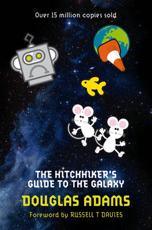
It's been a long while since I wrote a book review - the last one was Anansi Boys, back in the far off days of August - but procrastination can't hold anybody forever, so very recently I got round to writing a review for the Hitchhiker's Guide to the Galaxy. It's one of the most famous novels in all of science fiction, and I finally picked up a copy about two weeks ago on a trip to Liverpool.

But as you may have already noticed, this blog post is far too short to contain a proper book review. But don't panic! The review hasn't been washed away by the tides of the superinformation highway or anything ridiculous like that; it's just been published somewhere else.

The Cult Den, an up and coming website devoted to cult TV, literature, comics, films and pretty much everything else, recently asked for submissions from freelance writers, to write articles for the site. Since science fiction and fantasy novels - the types of book I usually like to read and review - fall under the heading of 'cult', I decided to submit a book review to the website. They were happy to publish the article, which I'm absolutely ecstatic about, as I'm pretty sure this is my first piece published by someone else.

The Cult Den is still in it's early stages, and is currently being hosted on Weebly; in many ways, it's similar to Re-Incarnated, in that they have the ambition to become the best of the best, but are still finding their feet. Even though the site is fairly new, though, they have a great selection of articles written by all manner of people on all manner of subjects, and there's plenty for everybody, no matter what your tastes. If you want to follow them on twitter @TheCultDen, I'm sure they would be very grateful.

And now, the moment you've all been waiting for; you can reading my review of the Hitchhiker's Guide to the Galaxy by clicking here. I'll probably submit another article to the Cult Den at some point in the future, but don't worry - the majority of the things I write will still be coming on this blog, when I get around to writing them. But on this occasion, this post is really just here to say 'Look, I did a thing, and they put it on their website! Look at it, look!' Thanks for reading, and please do check out the Cult Den and my article.

Saturday, 1 October 2011

A Warning

The following is a heartfelt message to all my friends and family...


It's a song by a comedian called Mitch Benn, and he's absolutely brilliant. I've pretty much spent most of today listening to his songs - he writes comedy music, like Bill Bailey or Tim Minchin. As well as a couple of songs about Doctor Who, he's also written songs about Harry Potter and Lord of the Rings - there's even a Beatles parody called 'I Am Not The Walrus'. I decided that since the finale of Series 6 of Doctor Who is on tonight, it would be a good time to post this particular song, just to warn you in case you didn't know already. ;)

Sorry, short blog post, I only really wanted to show you this song and mention Mitch Benn. But while you're here, I might as well mention my DW fanseries, Doctor Who: Re-Incarnated. Our second story, Twister, went online today, written by my good friend and co-head writer Mark. You can check it out here if you're interested.

Nothing more to say really. See you next time, in a proper blog post. Until then, thanks for reading.

Saturday, 24 September 2011

Almost Closing Time

I'm not exactly in a happy mood right now. As I write this, Closing Time is airing on BBC1, the latest episode of this show I watch, I might have mentioned it at some point, Doctor Who. I am, shockingly, not watching it. This is because my TV decided that ninety seconds into the new episode would be the perfect place to, of its own accord, switch to Channel 4 and stay there. Without changing back. At all.

So, rather than throw things at other things and cry tears of rage, I've decided to use the 45 minutes I've got until the episode is up on Iplayer to write something interesting and entertaining. Or maybe just ramble for three quarters of an hour. And because I can't get it off of my mind right now, I might as well talk about Doctor Who. After all, it's not like I usually talk about that or anything.

Why am I so obsessed with Doctor Who, anyway? I suppose the obvious answer is the escapism. Escapism is, in my opinion, quite simply the best thing that humanity has ever created. People read books or watch TV for different reasons; to be entertained, to be informed, to make themselves laugh or cry. I read books and watch TV because I want to escape. There's a reason I read science fiction and fantasy almost exclusively, and there's a reason I dislike stories set entirely within the real world. Fiction is, for me, a chance to go somewhere else, to live a life that's completely different from my own. Why would you want to read a story about real things that could really happen? That's no fun. You could just go out and live that story, rather than sitting at home reading it. But sci-fi, and fantasy, these are the stories that we can only ever experience through fiction, and that is why I think they're the most important genre of storytelling. This escape from real life in favour of a tailor-made reality, this escapism, is the draw for pretty much every form of media I enjoy. Books? Neil Gaiman novels and Harry Potter, or Skulduggery Pleasant. TV? Being Human, Misfits, and of course Doctor Who. None of these stories could ever happen, not in a million years. But through the minds of their creators, on screen or in print, they do. That's the appeal, you see?

So, I think that's part of my obsession with Doctor Who explained. It's journeys through time and space, constant danger and laughter and adventure, are utterly absurd, and of course that's why I love it. But I don't think that's all there is to it. Why is Doctor Who special in my heart, above all of those other stories I mentioned? Is it the endless multiera, multigenre, multimedia format that allows it to do anything and everything? Well, perhaps that has something to do with it, but that's not the real reason. Nope, the real reason is the Doctor himself.

He's a character etched into my mind, a fictional being more important to me than any real world celebrity. The core concepts of the character absolutely match with my idealised image of who I want to be as a person. He's the most intelligent person in any room at any given moment, and he uses his intelligence both to baffle people and to help them. He's confident and easy-going, always fighting for equality and justice and all things right. He's the person I want to be like, more than anyone else in existence.

aaaaaaaaaaand on that note, having gone from 'enthusiastic fanboy' to 'creepy obsessive', Closing Time has finally showed up on Iplayer and I'm off to watch it. So I guess this brings this ramble to a 'close', eh? In conclusion, I watch Doctor Who and I love Doctor Who not only because it's brilliant in every aspect EVER, but also because the Doctor is as perfect a character as has ever been created. Not in the flawless, Mary-Sue kind of way (though in my mind, he often is like that), but in a brilliantly crafted, work-of-art kind of way.

You will see that the title of this blog is 'Not Entirely Incoherent'. This is because parts of the blog make perfect sense. Unfortunately, this post has not been one of those parts. Thanks for reading!

Tuesday, 20 September 2011

He Sees

It's been a long while since my last blog post, going on two weeks now, and even then the last post I made was a Friday Night Who UK update. I mentioned back when I first started the blog that, if I couldn't get round to writing new and regular posts, I would fall back on some old material that I produced before I had this blog. This is a good thing both for me, the writer, and you, the reader. I don't have to struggle to create new content quickly if I don't have the time or willpower, but you're still able to read something you've never seen before and (hopefully) enjoy it just like you would a brand new blog post.

The first thing I came across while I was looking for something new to post was this poem I wrote a while back. It's very short and very rushed and a bit rubbish. On the plus side, though, it's all about the Slender Man! I wrote it one dull weekend day while me and a friend were running through old Marble Hornets episodes.

In the deep and the dark and the cold
He walks
It’s the young and the scared and the weak
He stalks
Through the holes in his head, without eyes
He sees
He’s a man in the forest, or a thing
In the trees.

His body is slender and his fingers
Thin
His mouth stretched wide like a ghostly
Grin
He hides in the midnight light,
Pitch black
Where he waits, ever patient, then he makes
His attack.

Don’t even try to run, because the
Slender Man’s back.

...Yeah, I told you it was a bit awful. I never was very good with poetry. Oh well.

Thanks for reading this short, poemtacular blog post. Hopefully I'll have a more content filled, interesting post up in the near future.

Friday, 9 September 2011

Friday Night Who UK: 9th and 16th September 2011

(If you don't know what Friday Night Who UK is, click here.)

So here's another Friday Night Who UK update that's coming a little later than it should have done. As I'm writing this, I've got about an hour until tonight's viewing starts, so I'll have to type pretty quickly. Basically, I went back to school on Monday, so I haven't had as much time as I would have liked, and this update was unfortunately quite low on my list of priorities. To make up for it, this is a two-in-one blog post, because it includes the update for next week's viewing as well.

First off, our viewing of the Daemons went well, with no hiccups - well, apart from the fun facts fiasco, wherein me and Mark attempting to out-trivia each other using the Daemons' wikipedia page. So if I ever use the words 'fun fact' in a tweet again, it's almost definitely a lie. Just so you know.

More importantly, what are we watching this week? Why, it's City of Death of course, featuring one Tom Baker. It's commonly regarded as one of the greatest stories of Baker's seven year run, so we should be in for a good evening. If you want to join me and Mark in our viewing of City of Death, you need to follow us on twitter (@KingOrokos and @Marcus_Joan respectively) at around 7pm UK time, which is in less than an hour as I'm writing this! You also need to use the #FridayNightWhoUK hashtag, and also the #CityOfDeath hashtag this week.

As I said, this post is also an update for next week - so, if you want to join us on the 16th of September, for our next Friday Night Who UK, we'll be watching Resurrection of the Daleks with Peter Davison. I don't know much about this story, which I suppose will make watching the episode all the more interesting. Obviously most of the information in the previous paragraph still stands, but you'll need to use the #ResurrectionOfTheDaleks hashtag this time round.

So, that's all for this relatively short double-post. 50 minutes left until City of Death as I type this! Oh well, I'm sure one person will read this before then... Maybe...

Next time on Not Entirely Incoherent: Words, arranged in patterns to form sentences! Thanks for reading.