Back in the long gone days of last July, I made a blog post all about websites I frequented and would recommend to other people. Obviously the list wasn't exhaustive and a lot of websites I'm very fond of weren't on there; some because I forgot about them, others simply because I only started using them after I wrote that post. I always intended to do a follow up post sometime, and as it's been nearly a fortnight since my last blog entry, I might as well do it now. So here are some places around the net that are worth checking out.
NaNoWriMo: I've mentioned NaNoWriMo more than once on this blog before, but for the sake of clarity; NaNoWriMo is short for National Novel Writing Month, an event which occurs every November wherein people across the world attempt to write a 50 000 word novel in 30 days. I took part in 2011's NaNoWriMo (and scored just over 16 000 words, so it wasn't exactly a roaring success) and hope to take part in 2012's event as well. The official website has forums where you can talk to other participants, but its main use during the event is to update your progress; the satisfaction you get when you watch the bar chart that represents your word count climb slowly higher is a great motivational tool.
Fanfiction and FictionPress: If I haven't made it obvious enough already on this blog, I love writing. Books, short stories, pretty much anything to do with the written word is my kind of thing. Fanfiction and FictionPress are two partnered websites that allow amateur writers to get their work onto the web, to be noticed and read. Fanfiction, as the name might have informed you, is all about fanfiction - works based on pre-established stories and worlds, ranging from Harry Potter and Doctor Who to pretty much everything else. FictionPress, meanwhile, publishes original stories in a variety of different genres. It's completely free to sign up and you can publish whatever you like. While this does mean there's a lot of sub par work on both sites that you'll have to sift through, it's worth it for the hidden gems you may find.
Tumblr: I won't go on about Tumblr too much, because I already did a post about it, but essentially it's a great microblogging platform that let's you share content created by other users, quickly and without hassle. It's also a great way of noting down quick thoughts that aren't really substantial enough for a proper blog post, but are too big to fit onto twitter.
Bulbapedia: Most of the independently run Wikis are quite low quality in comparison to Wikipedia itself, but this Pokemon Wiki is of an extremely high standard. It has over 20 000 articles, and is pretty much the go-to place for all Pokemon information and knowledge.
FutureMe: This is one of those websites that takes a really clever idea and runs with it. The concept of FutureMe is simple; you type up a message to your future self, set a time delay, and the message is sent to your own email address at that point in the future. As a result, you can write emails to yourself one year on, two years on, ten years on - or maybe just to the you of next week. Regardless of how far forward you send the email, it's a very clever and intriguing system that allows you to create a 'letter to the future you' without the risk of losing it or damaging it.
Nuzlocke: The Nuzlocke challenge is an immensely interesting idea that revolves around the Pokemon games. When playing any Pokemon game, you can take part in a Nuzlocke challenge by following the two rules; you can only catch the very first Pokemon you see in each area, and if any Pokemon on your team faints, it is 'dead' and gone for good, and you cannot use it again. While the challenge was devised to make the games more challenging, it also has the side effect of making you care much more for your slapdash team - the thought that you could lose a team member, permanently, is quite the ominous cloud that hangs over your head as you play. I tried a Nuzlocke challenge a while back on my copy of Platinum, and I actually did start to worry about my team member's safety. The Nuzlocke website is home to the Pokemon: Hard-Mode webcomic, a series of stories set in the Pokemon world following a character running through a Nuzlocke challenge, and they're drawn by the person who conceived the original idea of the challenge.
Rare Candy Treatment: Okay, this is the last Pokemon one, I promise. Rare Candy Treatment is a great, funny little website that infrequently publishes a Pokemon webcomic, filled with in-jokes and references to the games that make it a lot funnier if you're a big Pokemon fan.
Write Or Die: This website is a great way of boosting productivity while you're writing. The site tries to fight procrastination and distraction by punishing users who aren't writing. When you open the online version, you are given a blank text processor on which to type, after setting yourself a word count goal and a time limit. You are also allowed to pick from three different settings; gentle mode will pop up a box whenever you stop writing for longer than an allotted time period, telling you to get on with it; normal mode plays a really annoying noise out of your speakers at full volume whenever you stop; kamikaze mode will actually start to delete what you've written if you pause for too long. It's a really good way of getting first drafts done quickly and efficiently, though obviously it can sometimes be annoying if you need to stop momentarily to fact-check.
And with that, I'll wrap up on this edition of Awesome Websites. I realise that it's not a very content-heavy blog post, but in my defence I've been pretty busy recently, trying to get next month's story for Doctor Who: Re-Incarnated finished on time. Once February comes I'll be able to relax a bit and do something bigger, like a book review or something. Until then, thanks for reading, and please do check out some of those websites I've recommended.
Thursday, 26 January 2012
Awesome Websites 2

 I do book reviews, talk about video games, write delightfully inconsequential works of fiction. And talk about Doctor Who a lot. Seriously, there's an outrageous amount of Doctor Who involved.
Saturday, 14 January 2012
The End Specialist
 A few days ago I found a book tucked away on the bottom shelf of my bookcase. It was a novel, called The End Specialist, written by an author named Drew Magary, and I had never read it. I had picked it up from Waterstones on one of my trips into Liverpool and never gotten around to actually reading it. So, since I didn't have much else to do, I opened it up and started to read. I'm glad I did.
The End Specialist is the kind of story that takes a big, world-changing science fiction concept - what if a cure for ageing was invented? - and runs with it, spinning a tale of how the human race adapts to this new development. On this occasion, the story is delivered to us from the perspective of John Farrell, an everyman who begins the story by receiving the cure. The book then follows his life over the course of more than sixty years, as the cure spreads and the world's population balloons in size.
The most interesting thing about The End Specialist is the way it's presented. The story follows a blog format, with each chapter taking the form of a new post on John's blog. The majority of the chapters are from John's perspective and are tell the story of his day to day life, which is the main meat of the plot; however, several of the posts are links to interviews or news articles, and in these chapters we gain a wider insight into the world John is living in. The interviews range from scientists and politicians to pro-death terrorists and followers of a new religion, the Church of Man, which has sprung up in the wake of the cure. The news articles cover everything from wars and bombings to epidemics. It's very similar to the wide-reaching style of World War Z; however, because the central strand of John's life remains throughout the book, it gives the plot a structure, a sense of order that World War Z lacked. Because we keep intercutting from the zoomed-out, detached overview to a more personal perspective, the whole thing feels very interconnected, and you really feel like all of these different events are taking place in the same world.
Though the real advances in the plot often come in the wider form of news stories - the post-cure expansion of Russia, a theme which runs throughout the book, is rarely mentioned by John personally - John's story is still fascinating and entertaining. The book comes in four main phases; 'Prohibition', 'Spread', 'Saturation' and 'Correction'. Each phase is very different in terms of subject matter and tone, but as I said above, the recurring narration from John keeps the novel stable. 'Prohibition' deals with John receiving the cure while it is still illegal, and his reaction to that; 'Spread' shows how the human race begins to adapt their way of life to deal with an ageless world; 'Saturation' focuses on John becoming an End Specialist - this is an occupation which John takes up during the second half of the novel, and while I won't spoil what exactly that job entails, suffice to say it's an interesting and unique position, made possible by the cure. The book's final phase, 'Correction', sees the story take a dark and unexpectedly grim turn, as the vastly growing population begins to drain the Earth of its last resources. It's an unusual way to end a book, but it works, and it really serves to round off the theme of death that is omnipresent in the story.
In terms of characters the book is pretty mundane; John, while his motivations and personality are interesting and believably written, is not a particularly original character. None of the other members of the supporting cast jump out at me, except perhaps Matt, John's boss, who provides dark comic relief and several laugh-out-loud lines. Apart from him, though, many of the characters fit into basic archetypes. The worrying sister, the childhood sweetheart, the energetic best friend, and so on and so forth. It doesn't damage the story too much because of the wide, planet-spanning scope of the tale, but it would have been nice to see a few more creative characters in there somewhere.
Bits and Bobs
- The book was originally released in America, and I only found out after reading it that the novel's official title is actually The Postmortal. Both are appropriate titles, but because the English release was titled The End Specialist, and because I think the latter is a much cooler name for a book, I've stuck with that title for my review.
- I don't usually comment on a book's cover in these reviews because that's not really what books are about, but I just have to mention the image of the Grim Reaper, impaling himself on his own scythe, that appears on the front of this book. Not only is it mentioned in the story (John sees it in graffiti form, spray-painted on a wall somewhere early in the novel), it's also one of the cleverest visual metaphors for overcoming death I've ever seen. The whole reason I bought the book in the first place was this cover, which jumped out at me while I was browsing, so I suppose it can take the credit for finding me this novel.
Until next time, whenever that may be, thanks for reading my blog!
I do book reviews, talk about video games, write delightfully inconsequential works of fiction. And talk about Doctor Who a lot. Seriously, there's an outrageous amount of Doctor Who involved.
Sunday, 8 January 2012
Beware of Panthers
 I never got round to reviewing any of the stories from Doctor Who's sixth series because I'm not very good at keeping to deadlines, and by the time I'd managed to marshal my thoughts into something remotely sensible, weeks had passed and another episode had come out. That's why I usually review books, and not necessarily new ones; books have a longer shelf life than TV shows and as such, I don't have to rush to write a review while the subject is still relevant. But on this occasion, seeing as there isn't going to be another episode of Doctor Who for at least six months, I've decided to compile my thoughts on the recent Christmas special, The Doctor, the Widow and the Wardrobe.
A quick summary of the story for those who haven't seen the episode; after a woman named Madge Arwell, living in 1930s England, saves the Doctor's life, he promises to repay the favour one day. Three years later, Madge and her two children are spending Christmas in an old mansion in the countryside, and the Doctor shows up to make their Christmas the best they've ever had. Things quickly go wrong, as the Doctor's 'present' - a dimensional portal to a snowy, wintry wonderland - leads the four of them into terrible danger.
As stories go, it's decent if not spectacular. Writer Steven Moffat got some criticism for making last year's Christmas special, A Christmas Carol, too complicated for the casual Christmas audience; this year, it feels like he has swung too far in the opposite direction, as the story feels almost dumbed down for the casual viewers. It's often said that some Doctor Who episodes are written for adults, and some are written for children; this is an example of a story written primarily for a younger audience, and while there's nothing wrong with that, it does leave some of the show's older viewers feeling disappointed. The main bulk of the story, set in the wintry, Narnia-esque world on the other side of the Doctor's portal, failed to captivate in the way that much of the last series did.
In the story's defence, however, it certainly could have been a lot worse. There was a point in the episode, after the true nature of the winter forest was revealed, where I cringed in anticipatory dread. The reveal was obviously the set up for a heavy-handed environmental metaphor, the sort of 'humans are destroying the planet' message that would be much more effective if writers could present it more subtly (for some reason, environmentalism is one of those themes that TV shows can never seem to incorporate into their stories without shoving it down the viewer's throats). But then, the metaphor never came. Nobody comments on the damage humanity is doing, and not once is deforestation - an obvious real-world comparison to the events of the story - even mentioned. As a result, Moffat manages to put across a message without forcing people into thinking about it, which as I've said is a rare thing when it comes to environmentalism.
Though the scenes set in Narnia 2.0 ultimately come off as rather dull, some of the earlier, more whimsical scenes fare much better. The fast-paced sequence of the Doctor showing the Arwell family around their new home is the best part of the episode, mainly thanks to Matt Smith's manic performance as the Doctor. He manages to bring all of the Doctor's most likable qualities to the forefront in this episode, from childlike enthusiasm on the whirlwind tour, to sincerity and sympathy in the few scenes he gets with Madge. Speaking of Madge, Claire Skinner does some great work in this story, wholly deserving her one-time place in the opening credits. Just like Matt Smith, her character displays a wide spectrum of emotion throughout the story, and she succeeds in convincingly portraying each of those emotions.
But while the two title leads get pl
 enty to work with, many of the story's other actors are unfortunately shortchanged. Bill Bailey in particular, one of my favourite comedians, appears in a tiny role as an incompetent harvester, while Alexander Armstrong is given the small part of Madge's husband. It seems a shame to have cast such experienced and talented comic actors in parts that don't let them shine. It's similar to how Simon Pegg was cast in the role of the Editor way back in 2005's The Long Game - he does a flawless job of it, but he could have done so much more for the show if they had given him a better part. The only other actors who really get a significant amount of screen time are the two child actors, Holly Earl and Maurice Cole, in the roles of Lily and Cyril Arwell. They are a mixed bag; Lily is believably written and acted, whereas Cyril's character is all over the place - he is set up as being intelligent in the episode's earlier moments, but all he does is make stupid decision after stupid decision, ignoring all the obvious signs of danger and wandering into a trap.
Bits and Bobs
- The episode's final scene, where the Doctor reunites with Amy and Rory for Christmas dinner, lifted my spirits more than anything else that happened in the story. It could have felt tacked on, but instead they managed to seamlessly transition between the Doctor's goodbye to Madge and his visit to the Pond household. It also felt like a little bit more of a resolution to the series 6 finale, providing more closure than The Wedding of River Song managed to, so that the relationship between the Doctor and Amy/Rory is back to normal. In many ways, this final scene acts as set up for series 7, where the Doctor won't be travelling with the Ponds permanently, but instead popping back to visit them every so often.
- The pretitles sequence of this story has riled up a lot of fans because it's so scientifically inaccurate; the Doctor is essentially exposed to the open vacuum of space for several minutes. Now, while this isn't completely ridiculous if you look back to past stories - in Peter Davison's Four to Doomsday, the Doctor is also thrown out into the vacuum of space, so it's possible that Time Lords are naturally able to survive in those conditions - this doesn't fix all of the problems, because in Four to Doomsday the Doctor is holding his breath, suggesting he can't breathe in space; however, in The Doctor, the Widow and the Wardrobe, he's shouting and gibbering to himself as he plummets, so he clearly isn't holding air.
- Both of Matt Smith's Christmas specials have been based off of classic literature; A Christmas Carol and The Lion, the Witch and the Wardrobe respectively. Unfortunately, whereas last year's special pays homage to its source material - the Doctor actually takes inspiration from the book, and pretends to be the ghost of Christmas past - in this year's special, Narnia and CS Lewis are never actually mentioned, and so it feels less like an homage and more like the writer borrowing ideas. That the whole thing is a lot less tongue-in-cheek about its source material is one of the story's flaws.
Since this is a Doctor Who-themed blog post, it would be wrong not to include a link to my fanseries, Doctor Who: Re-Incarnated. Feel free to read any of our stories, including our own Christmas special, Ghosts of Christmas Past (written by brilliant guest writer Shaun Collins), or our most recent story, The Blue Box (written by me). As for the next blog post, it will most likely be a review of a novel I started reading recently called The End Specialist. Or it could be something else entirely. Until then, though, thank you very much for reading!
I do book reviews, talk about video games, write delightfully inconsequential works of fiction. And talk about Doctor Who a lot. Seriously, there's an outrageous amount of Doctor Who involved.
Wednesday, 4 January 2012
The Festive Season
In the two weeks since I last wrote a blog post, Christmas, the new year, and my birthday have all come and gone. So I thought I would sum up the past two weeks in a short blog post, since quite a lot of stuff has happened.
My cousins from Birmingham came up to see us around Christmas, which was nice (me and my family actually staye d in Birmingham for a few days about half a week before, so we've seen a lot of each other recently). We took them on a 'scenic tour' of the area; which basically involved walking through quite a lot of fields, then going to a pub. We ended up taking them to see the Dream, which is a sculpture on an old mining site. I got a picture of it, and it's basically just a twenty meter high girl's head. It looks almost false up close, like the face is just shadows cast by the sun in a certain way. It's a little odd to look at.
Unfortunately, as you can see from the photo, there wasn't any proper snow this year. We got a couple of days of slippy, ice slush that might have technically been snow if you squinted at it, but nothing in the way of proper, snowman-building, snowball fight snow. I'm still holding out for some early January snow like we got last year and the year before, but it's getting less and less likely every day.
Anyway, after my cousins went home, the rest of the holidays were pretty plain for me. I spent pretty much a whole day rewatching old episodes of Misfits after I got a boxset for Christmas, and another day playing Red Dead Redemption non-stop. The non-excitement climaxed on new year's eve, which I spent sat inside listening to music and generally not having fun. We set off a couple of lanterns around midnight (two of which crashed landed into somebody's back garden, oops) and watched the fireworks for a while, but that was pretty much it.
Then there was my birthday, which is the 2nd of January. I've been sixteen for a few days, and so far it's pretty much exactly the same as being fifteen. Also, I got this:
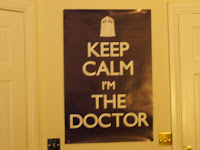
Which, as you can see, is extremely awesome in every way.
And, well, that's pretty much it. No wonder I don't do blogs about my actual life more often, this was kind of dull. Oh well. Hopefully I can use 2012 to do more genuinely exciting things. Until those exciting things, however, I'm done for now, so thank you for reading.
My cousins from Birmingham came up to see us around Christmas, which was nice (me and my family actually staye
 d in Birmingham for a few days about half a week before, so we've seen a lot of each other recently). We took them on a 'scenic tour' of the area; which basically involved walking through quite a lot of fields, then going to a pub. We ended up taking them to see the Dream, which is a sculpture on an old mining site. I got a picture of it, and it's basically just a twenty meter high girl's head. It looks almost false up close, like the face is just shadows cast by the sun in a certain way. It's a little odd to look at.
Unfortunately, as you can see from the photo, there wasn't any proper snow this year. We got a couple of days of slippy, ice slush that might have technically been snow if you squinted at it, but nothing in the way of proper, snowman-building, snowball fight snow. I'm still holding out for some early January snow like we got last year and the year before, but it's getting less and less likely every day.
Anyway, after my cousins went home, the rest of the holidays were pretty plain for me. I spent pretty much a whole day rewatching old episodes of Misfits after I got a boxset for Christmas, and another day playing Red Dead Redemption non-stop. The non-excitement climaxed on new year's eve, which I spent sat inside listening to music and generally not having fun. We set off a couple of lanterns around midnight (two of which crashed landed into somebody's back garden, oops) and watched the fireworks for a while, but that was pretty much it.
Then there was my birthday, which is the 2nd of January. I've been sixteen for a few days, and so far it's pretty much exactly the same as being fifteen. Also, I got this:

Which, as you can see, is extremely awesome in every way.
And, well, that's pretty much it. No wonder I don't do blogs about my actual life more often, this was kind of dull. Oh well. Hopefully I can use 2012 to do more genuinely exciting things. Until those exciting things, however, I'm done for now, so thank you for reading.
I do book reviews, talk about video games, write delightfully inconsequential works of fiction. And talk about Doctor Who a lot. Seriously, there's an outrageous amount of Doctor Who involved.
Monday, 19 December 2011
Rivers of London
 I spent the majority of yesterday finishing off a book I've been reading recently, Rivers of London, and since it's been nearly two months since I reviewed a novel, I decided to do a blog post about it.
Rivers of London is a textbook example of an urban fantasy novel; the story follows Peter Grant, a probationary constable working with the Metropolitan Police Service, who starts the story (much to his own surprise) by taking a witness statement from a ghost. Soon he is drawn into a wizarding apprenticeship, studying under Chief Inspector Nightingale, and finds himself working in a small, secretive branch of the MPS that deals with the supernatural. Over the course of the novel, he becomes involved in an investigation into a series of brutal, magic-related murders.
The most appealing thing about the novel is it's sheer readability. It's the kind of book that you sit down to read for five minutes and end up reading for three hours. The most obvious reason behind this is the excellent narration - the story is told from a first-person perspective, as we see everything that occurs in the novel through the eyes of our protagonist Peter. Author Ben Aaronovitch has done a brilliant job of making Peter a likable character; he balances the relatable everyman with whom the audience can sympathise, with the witty, intelligent central character the audience can root for. Peter's wry observations and exasperated sense of humour lend the novel a lighter tone, and provide plenty of laughs over the duration of the book. His perspective is unique, original and entertaining, and this makes it easy to devour the book in huge chunks, because even when the story falters a little, the way Aaronovitch tells the story through Peter never fails to keep the reader hooked.
I mentioned just now that the story stumbles at times, and while this is true, it's only a very small issue. Mostly the story flows smoothly and naturally, with the murder investigation progressing in such a way that new information is constantly unveiled, yet the reader remains intrigued throughout. For every plot thread that is wrapped up, a new one is unraveled, and this contributes to the readability I mentioned above; there is always something the reader is left waiting to find out, always something new to be discovered if you carry on reading for just a few more pages. But unfortunately there is one point, early on in the story, which I feel the author mishandled; the moment when Peter is properly introduced to magic. This is the stumbling block of the story. At the beginning of the novel, Peter has no knowledge of magic or the supernatural whatsoever. His only exposure to anything out of the ordinary is his talk with the ghost, right at the book's beginning. He spends the next few days pondering the experience, wondering whether or not the ghost was real. Then, in a scene that lasts roughly two pages, he is introduced to his mentor Nightingale and given a criminally short version of the 'magic is real' speech that is such a common thread in fantasy stories. It isn't so much the brevity of the scene that bothers me, it's more Peter's reaction - or rather, lack of reaction. Peter takes the news that vampires, ghosts and wizards are all real completely in his stride, to the point where he seems almost ridiculously detached from the whole thing. He goes from an ordinary copper to telekinesis, and at no point does he sit down and think 'Wow, I'm a sorcerer now.' It makes him seem emotionless, and that doesn't gel with how he comes across in the rest of the novel.
I've banged on quite a bit about that one scene, so I'll reiterate that it's only a small issue. Once Peter is inducted into his wizard's apprenticeship under Nightingale, the novel adopts a near-flawless flow of tension, mystery and humour, the story slowly and subtly building up to a fantastic climax (coupled with a betrayal from one character I won't spoil), and overall I thought the plot was wonderful. It wraps itself up quite nicely, though several loose strands are left hanging for the sequel, Moon Over Soho (which I have yet to read). It's a great example of a book that stands on it's own but also works as the push-off point for a series. So don't be put off when I say that this one, small part of the book's story was flawed, because ultimately it's quite a superb piece of plotting.
And of course, I couldn't possibly review Rivers of London without talking about the eponymous city itself. It's clear that Aaronovitch is extremely fond of London, and it's also clear that he's hugely knowledgeable about it. Trivia and tidbits of London history seep through the pages of this novel, particularly in relation to Thames river and the various other rivers that flow through, past, or near London - hence the novel's title. In the hands of a less talented writer this could become tedious very quickly, but fortunately in this case all of the slivers of knowledge are delivered through Peter, a Londoner himself. The information is seamlessly slipped into Peter's narrative of the story in a way that feels unforced and in character, so Aaronovitch can show his love for the city all he likes without boring the reader. On the contrary, this added level of detail makes the realistic depiction of the London police service stand out, which in turn emphasises how uncannily odd the various supernatural events are. So by adding in tiny snippets of London trivia, the book manages to do what every urban fantasy novel aspires to do, and stands the juxtaposition of normal and unnatural front and center, obvious and unmissable, in the eyes of the reader.
Bits and Bobs
- Much to my surprise, it turns out Ben Aaronovitch has also written for Doctor Who! After I was finished reading I read the 'about the author' paragraph and apparently he wrote the McCoy story Remembrance of the Daleks, and the later McCoy story Battlefield. As I'm sure you all know, being involved in Doctor Who in any capacity is worth ten billion Alex points, so well done to him.
- My favourite line by far in the novel is located in an early discussion between Peter and Nightingale.
'So magic is real,' I said. 'Which makes you a... what?'
'A wizard.'
'Like Harry Potter?'
Nightingale sighed. 'No,' he said. 'Not like Harry Potter.'
'In what way?'
'I'm not a fictional character,' said Nightingale.
I'll never be quite sure why fictional characters saying 'I'm not a fictional character' amuses me so much, but it does. It really, really does.
In far less interesting me-related news, I broke up for the Christmas holidays on Friday, so I'm free until 2012! This means I have two weeks to engage in all of my favourite hobbies, like sleeping, eating pringles, and staring vacantly into space wondering absently if I should try and get something productive done. Ah, good times. But anyway, I hope you enjoyed this review, and until next time, thanks for reading.
I do book reviews, talk about video games, write delightfully inconsequential works of fiction. And talk about Doctor Who a lot. Seriously, there's an outrageous amount of Doctor Who involved.
Monday, 12 December 2011
Tumblin' in the Wind
Over the past two weeks or so I've been using Tumblr a lot. I'm sure I don't need to explain what Tumblr is to you, but for any readers who have been living under particularly large boulders, it's basically a blogging site, a rival to Blogspot I suppose (shhh, don't tell them I've defected). There are a lot of differences between the two sites, and rather than pick one over the other I've ended up using them both for different things.
Blogspot is a much more professional service. The layouts it offers you for your blog are arranged in a much neater, easier-on-the-eye fashion. It's a similar story for extra pages; the 'Doctor Who: Re-Incarnated' and 'Friday Night Who UK' tabs at the top of this blog are a lot easier to find than the cramped list of links on Tumblr. The archiving system on Blogspot stands out most emphatically as the better one; Tumblr's archive is a slapdash, chaotic mess of posts set out roughly in rows, whereas Blogspot's dropdown list is really easy to navigate through. Blogspot lets you create a 'proper' blog, so you can write reviews, essays, or just ramble on about the comparative benefits of Tumblr for half an hour. *Cough*
But just because Tumblr is a bit more of a makeshift system, doesn't mean it isn't useful. Whereas Blogspot is all about quality, Tumblr gives you quantity. So far in the six months I've been using this blog, I've made around 35-40 posts. My total number of posts for Tumblr at this very moment, however, is 154. Tumblr is all about quick, easy blogging; just as Twitter is a faster, more compacted social network than Facebook, so Tumblr is a faster, more compacted blogging platform than Blogspot. I think this is mostly down to Tumblr's 'reblog' feature - again, you almost definitely already know what this is, but for clarity it's a feature that allows you to repost somebody else's blog post on your own blog. So, for example, if somebody posts a funny picture, you can reblog that picture and it appears on your Tumblr page, for all of your followers to see, under the caption of '(Your name) reblogged this from (Person who made the funny picture)'.
Tumblr is more suited in general, I think, to shorter posts. The majority of the posts on Tumblr are images or GIF files, and most of the text posts are only a couple of sentences. It's almost like a halfway mark between Twitter and Blogspot, because you can note down a couple of thoughts that would be impossible to encapsulate in 140 characters, but not enough to fill a proper blog post.
Because the two different sites fit different niches, I'm going to keep using both of them for different things. This blog will continue unabated as normal; if for whatever reason you can't stand Tumblr, don't worry, I'm not going to start moving my content over to there instead. But I am going to be using Tumblr if I ever have an idea or an observation to make, and I want to share it but it's just a couple of lines long, so it would be worthwhile checking my page out. Oh, and I'll also be reblogging lots and lots of Misfits GIFs, because there is no good reason not to.
The point I'm trying to get to, which is basically what this whole post has been leading up to, is 'hey, I have Tumblr, go follow me on Tumblr.' And, without further ado, here I am on Tumblr. I will try and find a space to put a permanent link to it somewhere on the sidebar of this blog, so newcomers will always be able to find me on Tumblr, but for now, you'll have to just cope with this.
Thank you very much for putting up with yet another floaty, dreary blog post that doesn't really contribute anything to anyone. I promise, honestly, the next post will be something constructive like a book review or something, and won't have the word 'Tumblr' in it at all. For today, however, this is all I've got. Thanks for reading.
PS: I believe I may have broken the first rule here (the first rule of Tumblr is don't talk about Tumblr), but I won't tell if you won't.
I do book reviews, talk about video games, write delightfully inconsequential works of fiction. And talk about Doctor Who a lot. Seriously, there's an outrageous amount of Doctor Who involved.
Saturday, 10 December 2011
Music Videos
One thing I always found really confusing when I was younger was the concept of music videos. I've always loved music, but the idea of a short video to accompany a song seemed off somehow. Music is an aural medium, meant to be listened to, so it often feels silly to be watching a 'music video' - it's a blend of two different forms and when I was younger I didn't think that it could work. Since then I've become a lot more accepting of music videos; obviously they serve a purpose, allowing the music to appear on TV channels and YouTube. These are both visual displays and music videos allow artists to get their songs on those displays; and having your song played on TV or on a video-sharing site will increase public awareness of the song, and of course that in turn will lead to higher sales. So I do see why music videos have to exist. However, I've never really embraced them. I've always preferred just listening to a song over watching the video, even until very recently.
In the last month, though, I've had my opinion of music videos mixed up yet again. I watched two music videos that made me feel that they were not only necessary - they improved on the original song.
The first one was this video for the song Shake Up Christmas by Train. I was cycling through some of Train's tracks on YouTube after a friend (with excellent taste in music) told me to listen to their song Drops of Jupiter. Anyway, while I was looking through their song list, I found a Christmas track from last year, and thought to myself 'Well, it is the Christmas season after all,' and gave it a look. Now, I really like this song on it's own - it's cheery and merry and the singer has a cool voice. But it's the video that really made the experience for me, and that's never happened before. I think the reason this video appealed to me where others have failed is because it tells such a simple, heartwarming story, and it tells it so well. The interlinked lives of the five or six major characters in the story, and the 'Christmas magic' that brings it together - and of course, because it's a music video, the story is told entirely through direction. A huge majority of the music videos I've seen make no attempt to tell a proper, fleshed out story, and those that do often rely on the song's lyrics to provide cohesion. In Shake Up Christmas, on the other hand, the video works as a standalone piece in its own right. You could mute the sound and it would still make complete sense (though that would be a bit counter-intuitive, wouldn't it?). I think that's another major factor in me liking it - it works as a standalone piece of art.
The other music video I saw was Alex Day's new song Forever Yours. Alex Day is a YouTube musician, so the vast majority of his work is displayed primarily through the Internet. The logic behind me liking this video is a bit harder to pin down, because the story isn't as clear as in Shake Up Christmas' video; it took me a few watches to properly understand what was happening in this one, so clearly the story wasn't the primary appeal. I think this time round it has a lot more to do with how 'clever' the video is. The direction flips between two different styles; an amateur, homemade production, and a more high-budget, professional video. Not only does it make the video more interesting to view, it sharply shows the contrast between different levels of filmmakers, from kids with video cameras making films in their gardens, to a proper film crew with a director and editing team. I think this makes it a lot easier to appreciate the effort put into making the video, on both sides of the coin. On the amateur side, it shows how hard they have worked to create something realistic-ish with no fancy equipment or software, and how they have had to use smart filming techniques to bypass scenes that would otherwise be expensive to film. On the professional side of the coin, it shows how much hard work and time goes into making something so high-end, something in a different league from most small-time video makers. This makes watching the video a more satisfying experience.
Ultimately, I'm not 100% sure why both of these videos suddenly jumped out at me and made me appreciate music videos more as an art form. Perhaps it has something to do with the reasons above, or perhaps there's something else that I've missed. Regardless, I'm now a lot more agreeable with the idea of music videos being just as important as songs (but not more important - the song is always the primary piece of media). That's all from me this time - I know, it wasn't really a very substantial post, but hey, I needed to write something, and this topic burst forth from my head. I think - fingers crossed - the next post might be a book review, if I can keep on schedule. For now, though, goodbye, and thanks for reading.
In the last month, though, I've had my opinion of music videos mixed up yet again. I watched two music videos that made me feel that they were not only necessary - they improved on the original song.
The first one was this video for the song Shake Up Christmas by Train. I was cycling through some of Train's tracks on YouTube after a friend (with excellent taste in music) told me to listen to their song Drops of Jupiter. Anyway, while I was looking through their song list, I found a Christmas track from last year, and thought to myself 'Well, it is the Christmas season after all,' and gave it a look. Now, I really like this song on it's own - it's cheery and merry and the singer has a cool voice. But it's the video that really made the experience for me, and that's never happened before. I think the reason this video appealed to me where others have failed is because it tells such a simple, heartwarming story, and it tells it so well. The interlinked lives of the five or six major characters in the story, and the 'Christmas magic' that brings it together - and of course, because it's a music video, the story is told entirely through direction. A huge majority of the music videos I've seen make no attempt to tell a proper, fleshed out story, and those that do often rely on the song's lyrics to provide cohesion. In Shake Up Christmas, on the other hand, the video works as a standalone piece in its own right. You could mute the sound and it would still make complete sense (though that would be a bit counter-intuitive, wouldn't it?). I think that's another major factor in me liking it - it works as a standalone piece of art.
The other music video I saw was Alex Day's new song Forever Yours. Alex Day is a YouTube musician, so the vast majority of his work is displayed primarily through the Internet. The logic behind me liking this video is a bit harder to pin down, because the story isn't as clear as in Shake Up Christmas' video; it took me a few watches to properly understand what was happening in this one, so clearly the story wasn't the primary appeal. I think this time round it has a lot more to do with how 'clever' the video is. The direction flips between two different styles; an amateur, homemade production, and a more high-budget, professional video. Not only does it make the video more interesting to view, it sharply shows the contrast between different levels of filmmakers, from kids with video cameras making films in their gardens, to a proper film crew with a director and editing team. I think this makes it a lot easier to appreciate the effort put into making the video, on both sides of the coin. On the amateur side, it shows how hard they have worked to create something realistic-ish with no fancy equipment or software, and how they have had to use smart filming techniques to bypass scenes that would otherwise be expensive to film. On the professional side of the coin, it shows how much hard work and time goes into making something so high-end, something in a different league from most small-time video makers. This makes watching the video a more satisfying experience.
Ultimately, I'm not 100% sure why both of these videos suddenly jumped out at me and made me appreciate music videos more as an art form. Perhaps it has something to do with the reasons above, or perhaps there's something else that I've missed. Regardless, I'm now a lot more agreeable with the idea of music videos being just as important as songs (but not more important - the song is always the primary piece of media). That's all from me this time - I know, it wasn't really a very substantial post, but hey, I needed to write something, and this topic burst forth from my head. I think - fingers crossed - the next post might be a book review, if I can keep on schedule. For now, though, goodbye, and thanks for reading.
I do book reviews, talk about video games, write delightfully inconsequential works of fiction. And talk about Doctor Who a lot. Seriously, there's an outrageous amount of Doctor Who involved.
Subscribe to:
Posts (Atom)